
For many organizations, choosing Azure, AWS, or Google Cloud has been the obvious decision in recent years. These platforms make it easy to get started quickly, offer a high degree of flexibility, and provide a broad ecosystem of services.
However, we’re seeing that this choice is no longer as straightforward as it was a few years ago. Not because these platforms have suddenly become less relevant, but because organizations are starting to assess their cloud environments more critically. Costs are rising, dependencies are increasing, and questions around data sovereignty and control over storage locations are becoming more prominent.
We’re seeing this reflected in recent projects as well. Clients are increasingly asking whether applications can run outside of the major hyperscalers—for example, in an independent European cloud or a private cloud environment.

The trigger Is rarely just one thing
Such questions rarely stem from a single concern. Sometimes it starts with infrastructure costs, which turn out to be much higher over time than initially expected. In other cases, it’s about dependency on a specific platform, or the realization that an application has gradually become difficult to move.
For some organizations, the location of data also plays a clear role. Where is data stored? In which region is the infrastructure running? And how much control do you still have over it?
These are not purely theoretical questions. Once a platform plays a critical role in an organization’s day-to-day operations, they become very concrete architectural decisions.
European cloud as an alternative
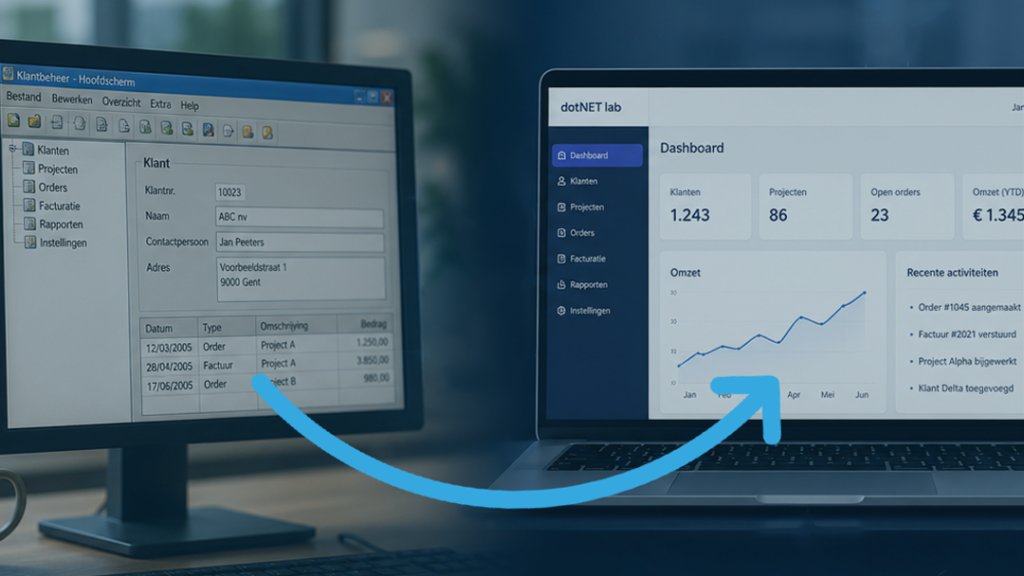
In several recent projects, a migration to a European cloud has come into focus. This is not just about moving servers or workloads, but about re-evaluating the underlying architecture.
Which parts of an application truly depend on a specific cloud provider? Which choices are historical but no longer necessary today? And where can simplification or greater flexibility be introduced?
That’s exactly what makes these trajectories interesting. A migration exercise is often also a moment to reassess how a platform is built and which choices are most sustainable in the long term.

Cost comes back into focus
One of the elements that often comes up in these evaluations is infrastructure cost. In projects where workloads were moved from Azure to a European cloud provider, we regularly saw a significant drop in costs. In some cases, the difference averaged up to a factor of ten.
Of course, that doesn’t mean every environment can simply be moved one-to-one. Not every application has the same technical dependencies, and not every workload lends itself to the same optimizations. But it does show that it can be worthwhile not to take existing cloud choices for granted.
For applications with a relatively stable usage profile or a more traditional architecture, a European cloud can be particularly attractive in this regard.
Cloud-independent development makes a big difference
What consistently proves important in these trajectories is how applications are built. Applications that rely heavily on proprietary services from a single provider are often harder to move. Applications designed to be more cloud-independent offer much more flexibility to change infrastructure models later on.
That’s why cloud-agnostic development remains an important principle. Not as a dogma, but as a pragmatic architectural choice. The fewer unnecessary dependencies you introduce, the more freedom you retain in the future.
This becomes especially important when costs, regulations, or operational needs change. At that point, it makes a big difference whether an application is still relatively portable or fully locked into one ecosystem.
Data storage within Europe
For organizations that are consciously addressing data sovereignty, the location of infrastructure and storage is an important factor. In these trajectories, hosting is provided in Finland, Germany, and Switzerland.
Depending on the project context, this can be a key argument. For some organizations, it’s an added benefit; for others, it’s an explicit requirement. In both cases, it’s a factor that clearly plays a bigger role in cloud decisions today than it did in the past.

Private cloud
Not every organization revisiting its cloud strategy automatically looks toward a public European cloud. In recent projects, private cloud has also come up more frequently.
In this model, a dedicated environment is set up where an organization runs its platform on a cluster of virtual machines. This approach is particularly interesting when predictability, simplicity, and clear boundaries are more important than access to a very broad ecosystem of cloud services.
For certain workloads, this results in a strong balance between cost, performance, and manageability. Especially when there is no strong need for hyperscaler-specific services, a private cloud often proves to be a highly practical alternative.
Not an ideological story, but a practical consideration
What stands out is that these questions are rarely ideological. Organizations are not necessarily looking to move “away from the cloud,” nor specifically “away from hyperscalers.” More often, it’s a practical exercise: does the original choice still fit current needs?
Sometimes the answer is yes. Sometimes a European cloud or private cloud turns out to be a more logical model. And sometimes a hybrid approach is the most realistic outcome.
That’s exactly why it’s useful to revisit this exercise from time to time—not based on general beliefs, but based on the concrete reality of costs, architecture, compliance, and operational management.
A question that comes up more and more often
What seemed like a niche question a few years ago now comes up much more frequently. Organizations want better visibility into their costs, more control over their data, and greater flexibility to adjust their infrastructure choices in the future.
As a result, European cloud and private cloud are becoming serious options to consider for more and more projects. Not as a universal replacement, but as a valid alternative in situations where flexibility, control, and predictability are once again becoming more important.